Free groceries, once a week, for anyone in the county.
No ID. No proof of income. You sign one line at the desk saying you need it, and you pick from the shelves what your household eats. This page says exactly what happens, so there are no surprises at the door.
Four steps, none of them a form
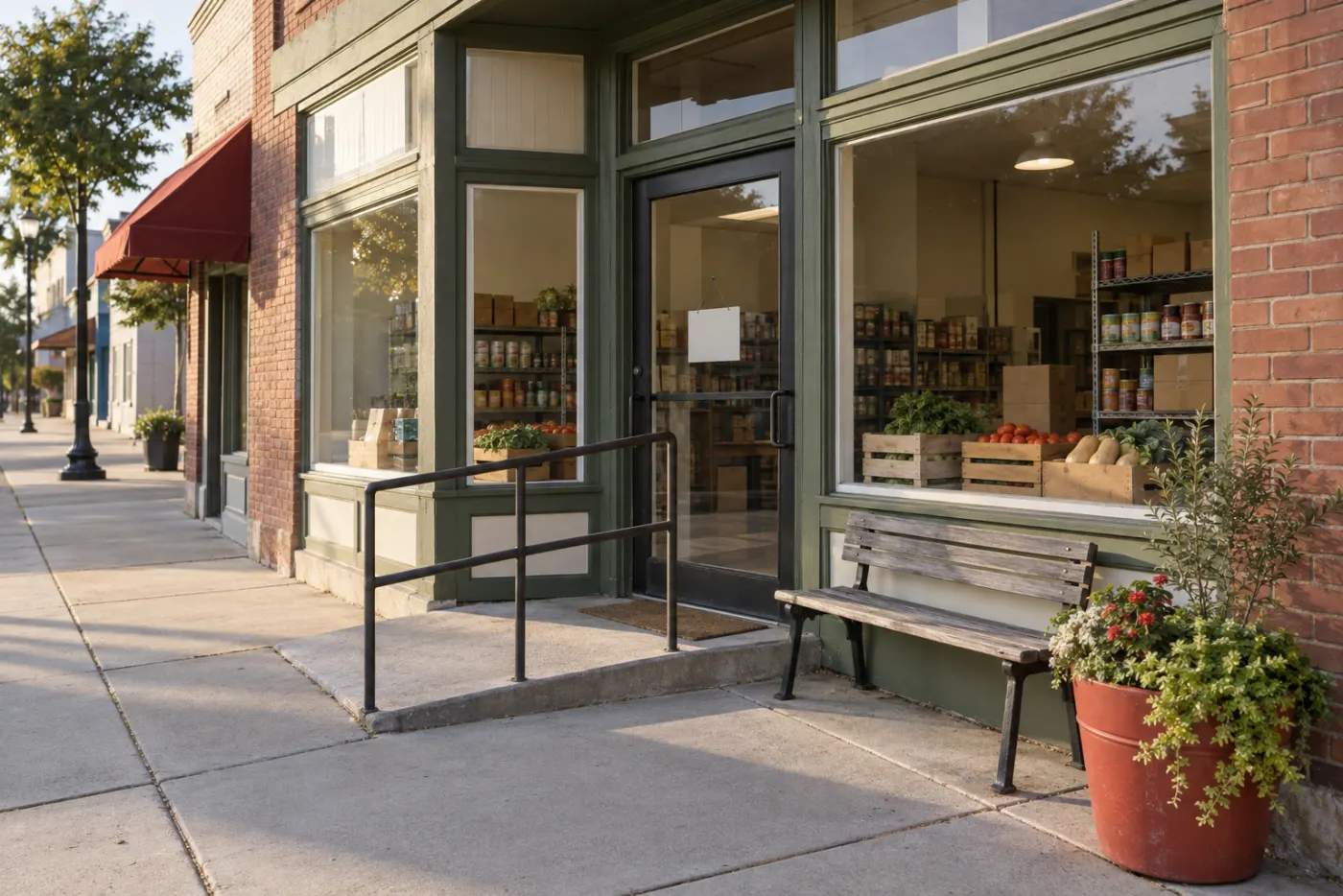
No appointment. The current hours and any closure are at the top of this page. Come by car, by bus (route 2 stops at the corner) or on foot; there is a ramp and a bench at the door.
Household size and one signed line saying you need food. No ID, no pay stub, no address check. What the line says, and why, is explained below.
Take a cart. Shelf tags say how many of each a household your size may take; a volunteer can walk with you if you like. Fresh produce, bread, eggs and frozen meat when we have them.
Once a week, every week, for as long as you need to. Nobody counts how many times. If something you needed was not on the shelf, tell the desk; it goes on the needs list.
When we are open
Tuesday noon to 3 p.m. · Thursday 4 to 7 p.m. · Saturday 9 a.m. to noon · closed Thursday 26 November
Staff type the hours and any closure once, on one sheet. The card at the top of this page, the home page, the footer, what Google reads and the pantry’s Business Profile line all come from it, so they cannot disagree.
What it says, and why
Some of the food on our shelves comes from the USDA through The Emergency Food Assistance Program (TEFAP). To hand it out, the program asks us to have you confirm — by signing, not by proving — that your household’s income is under the limit the state sets. The line reads roughly: “I declare that my household of __ people has an income at or below the program’s limit.” You sign it each visit. Nobody checks; nobody asks for papers.
If your income is above the limit, say so and you still get groceries — from the shelves that are not USDA food, which is most of them.
Where this comes from: the program’s rule lets each state set the income limit between 185 and 300 percent of the federal poverty guidelines (7 CFR 251.5(b); the current table is on fna.usda.gov). Our food bank’s requirements say eligibility is self-declared at every visit and that no ID, Social Security number or proof of income may be asked for. This sample site reports those rules as they are written; it does not advise on them, and a real pantry would link its own state’s form here.
Nothing. Really.
If you are picking up for a neighbour who cannot come, tell the desk their household size and sign for them; that is allowed and common.
Comida gratis, una vez por semana, para cualquier persona del condado
Sin identificación, sin comprobante de ingresos, sin cita. En el mostrador firma una línea que dice que su hogar necesita comida; eso es todo el trámite. Después escoge de los estantes lo que su familia come.
Horario: martes de mediodía a 3 de la tarde, jueves de 4 a 7 de la tarde, sábado de 9 de la mañana a mediodía. Cerrado el 26 de noviembre.
Dónde: 61 Quarry Road, la antigua ferretería. Hay rampa y banco en la puerta.
Los jueves por la tarde hay voluntarios que hablan español en el mostrador. En otros días, con calma y por señas nos entendemos igual.
Spanish on Thursdays, patience every day
About one household in eight speaks Spanish at home. Two Thursday-evening volunteers are bilingual and the desk sheet is printed in both languages. Program information can be made available in other languages on request — the USDA statement below says so, and it applies here.
The Spanish block on the left is a summary, not a translation of the whole page; the hours in it are read from the same sheet as everything else, so they stay right when staff change them.
Reserve a time, if you would rather not wait
You never need a reservation. Some people like knowing a cart is set aside and the line is short; this form shows how that works. It asks a first name, a household size and a day — nothing else — and in this demonstration it sends nothing and stores nothing.
If we are closed, or too far
211. Call 211 or use 211.org for every pantry, meal site and utility-help program in the county, any hour.
Another pantry. Feeding America’s locator finds the regional food bank for any ZIP code, and the food bank’s own site lists every partner pantry and its hours. Our food bank, Three Rivers Food Bank, is invented for this demonstration and has no website to link.
SNAP. Monthly grocery money from the state; applying does not affect coming here. The USDA keeps a directory of each state’s SNAP office.
The intake tool a real pantry uses. Reservations and check-in on a real site run in the pantry’s own system (FoodBank Manager, PantrySoft or FreshTrak, for example), and this website would link out to it rather than hold anyone’s details itself.
Printed in full, because the program asks for it
In accordance with Federal civil rights law and U.S. Department of Agriculture (USDA) civil rights regulations and policies, the USDA, its Agencies, offices, and employees, and institutions participating in or administering USDA programs are prohibited from discriminating based on race, color, national origin, religion, sex, disability, age, marital status, family/parental status, income derived from a public assistance program, political beliefs, or reprisal or retaliation for prior civil rights activity, in any program or activity conducted or funded by USDA (not all bases apply to all programs). Remedies and complaint filing deadlines vary by program or incident.
Persons with disabilities who require alternative means of communication for program information (e.g., Braille, large print, audiotape, American Sign Language, etc.) should contact the State or local Agency that administers the program or contact USDA through the Telecommunications Relay Service at 711 (voice and TTY). Additionally, program information may be made available in languages other than English.
To file a program discrimination complaint, complete the USDA Program Discrimination Complaint Form, AD-3027, found online at How to File a Program Discrimination Complaint and at any USDA office or write a letter addressed to USDA and provide in the letter all of the information requested in the form. To request a copy of the complaint form, call (866) 632-9992. Submit your completed form or letter to USDA by: (1) mail: U.S. Department of Agriculture, Office of the Assistant Secretary for Civil Rights, 1400 Independence Avenue, SW, Mail Stop 9410, Washington, D.C. 20250-9410; (2) fax: (202) 690-7442; or (3) email: [email protected].
USDA is an equal opportunity provider, employer, and lender.
Source: the USDA nondiscrimination statement for programs other than SNAP and FDPIR, copied word for word from fns.usda.gov on 18 September 2026 (that page says it was updated 28 August 2026). Feeding America West Michigan’s TEFAP distribution requirements (June 2023) say the full statement must be on a partner agency’s website alongside the USDA programs and on its flyers, and that a current 11×17 “And Justice for All” poster hangs at every site. This sample pantry reports those requirements as its food bank states them; it does not advise on them.